
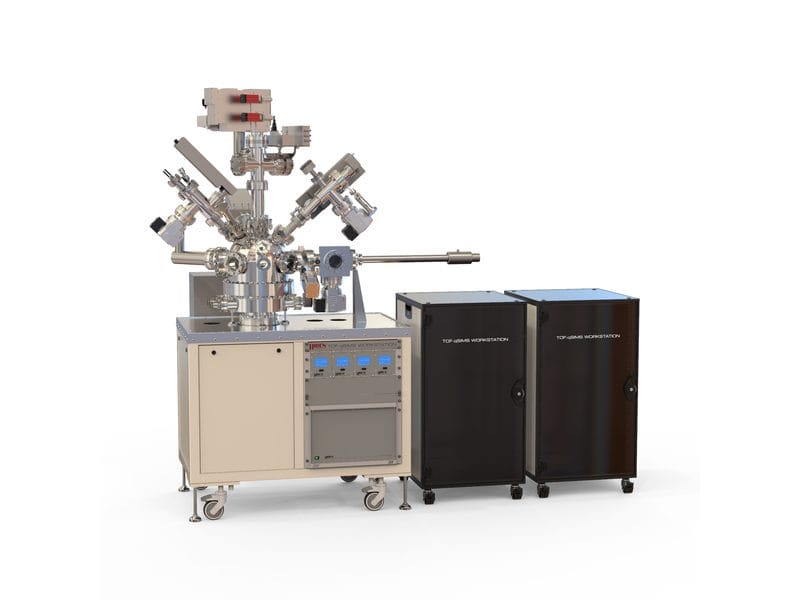
ToF-qSIMS Workstation.
A time of flight quadrupole SIMS system offering static ToF-SIMS capabilities and high dynamic range depth profiling from the quadrupole SIMS.
Key Features.
- Fully integrated and optimized for high performance SIMS analysis
- Dual column qSIMS and ToF SIMS analyzers
- qSIMS analyzer for dynamic SIMS, featuring high dynamic range depth profiling
- ToF-SIMS analyzer for static SIMS, enabling top monolayer specificity
- Hyperspectral imaging and depth profiling for rapid determination of spatial distributions
- Mass range 6 to 10 000 amu and 1500 FWHM resolution
- IG20 primary gas ion gun for enhanced secondary ion emissions for SIMS
- Hiden Cs metal ion gun for dynamic and static SIMS
Specifications.
- Analyzer
- Dual column qSIMS and ToF SIMS analyzers
- Mass range options
- 6 to 10 000 amu
- Detection limit
- Trace components measured to sub-ppm levels
- Ionization
- Dynamic SIMS (qSIMS analyzer) and static SIMS (ToF-SIMS analyzer)
- Format
- Integrated system with a multi-port UHV chamber
- Control software
- Hiden MASsoft Professional and SIMS Mapper
- Mass resolution
- 1500 FWHM
- Primary ion sources
- IG20 gas primary ion gun and Hiden Cs metal ion gun
- SNMS
- High sensitivity SNMS mode included
- SIMS enhancement
- Oxygen flood, electron charge neutralization and vacuum bakeout included as standard
- Imaging
- Hyperspectral imaging and depth profiling
Downloads.
Hiden's published documents for this instrument.
Related instruments.
SIMS Workstation
High performance static and dynamic SIMS for surface composition analysis and depth profiling, with SNMS for quantification in thin film measurements.
Compact SIMS
A SIMS tool designed for fast and reliable characterization of layer structures, surface contamination and impurities, with sensitive positive ion detection.
AutoSIMS
A self-contained automated SIMS tool for routine and repetitive surface analysis of thin films, contamination and doping, in conductive and insulating material.
Dual Polarity SIMS Workstation
The Dual Polarity SIMS Workstation simultaneously detects positive and negative ions using two opposing EQS spectrometers. Designed for ultra-thin layer analysis and battery research, it is ideal for studying materials such as the solid electrolyte interphase (SEI) layer.
Talk to an applications engineer.
Describe the experiment. An applications engineer reads it personally and typically replies within one business day.
Or call 1-888-96-HIDEN, Monday to Friday, 8:30am to 5pm ET.