
Ion Source Options for Residual Gas Analyzers.
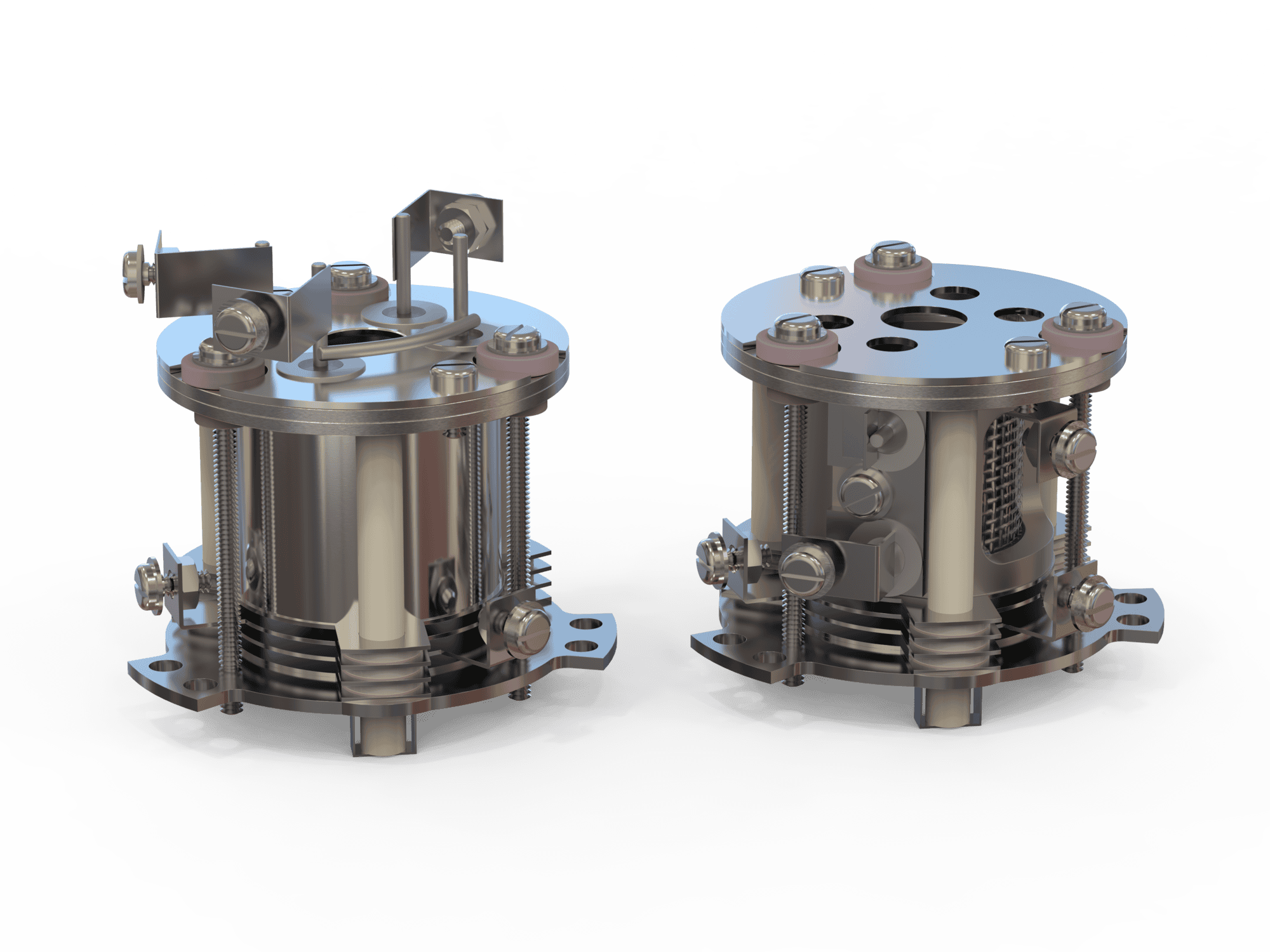
Hiden offers interchangeable electron impact and application-specific ion sources for configuring residual gas analyzers around pressure, sample geometry and gas chemistry.
Key Features.
- Interchangeable ion source options allow each residual gas analyzer to be configured around the pressure, geometry and gas chemistry of the application
- The standard radial source provides a general purpose configuration for routine residual gas analysis
- The UHV low-profile source positions the ionization region closer to desorption surfaces, supporting UHV TPD studies
- Closed sources accept direct gas input with differential pumping, extending analysis to higher-pressure studies
- Basic and XBS cross beam sources provide an unobstructed beam path for molecular beam analysis and MBE deposition monitoring
- Platinum, gold-plated and vacuum-fired source options improve operation with reactive gases or reduce source outgassing in demanding UHV measurements
- Two orthogonal unobstructed pathways through the laser cross beam source provide laser photon ionization within the source cage, offering an alternative to electron impact and electron attachment ionization
Software.
Every system ships with control software. Which package suits depends on whether you are running quantitative gas analysis, evolved gas work, or building your own acquisition routines.
Downloads.
Hiden's published documents for this instrument.
Related instruments.
RGA Series
A broad range of quadrupole residual gas analyzers for contamination monitoring, leak detection and analysis of the species within the vacuum chamber.
EPIC Research-Grade UHV and XHV Mass Spectrometer
The Hiden EPIC and EPIC 1000 Series extend high-performance residual gas analysis to neutrals, radicals and positive or negative ions.
IDP Ion Desorption Probe
The Hiden IDP is a quadrupole ion desorption probe for direct analysis of low-energy ions, neutrals and radicals generated in UHV surface science experiments.
3F PIC Triple-Filter Mass Spectrometers
The 3F PIC Series is designed for fast-event studies that demand high sensitivity and time resolution.
Talk to an applications engineer.
Describe the experiment. An applications engineer reads it personally and typically replies within one business day.
Or call 1-888-96-HIDEN, Monday to Friday, 8:30am to 5pm ET.